
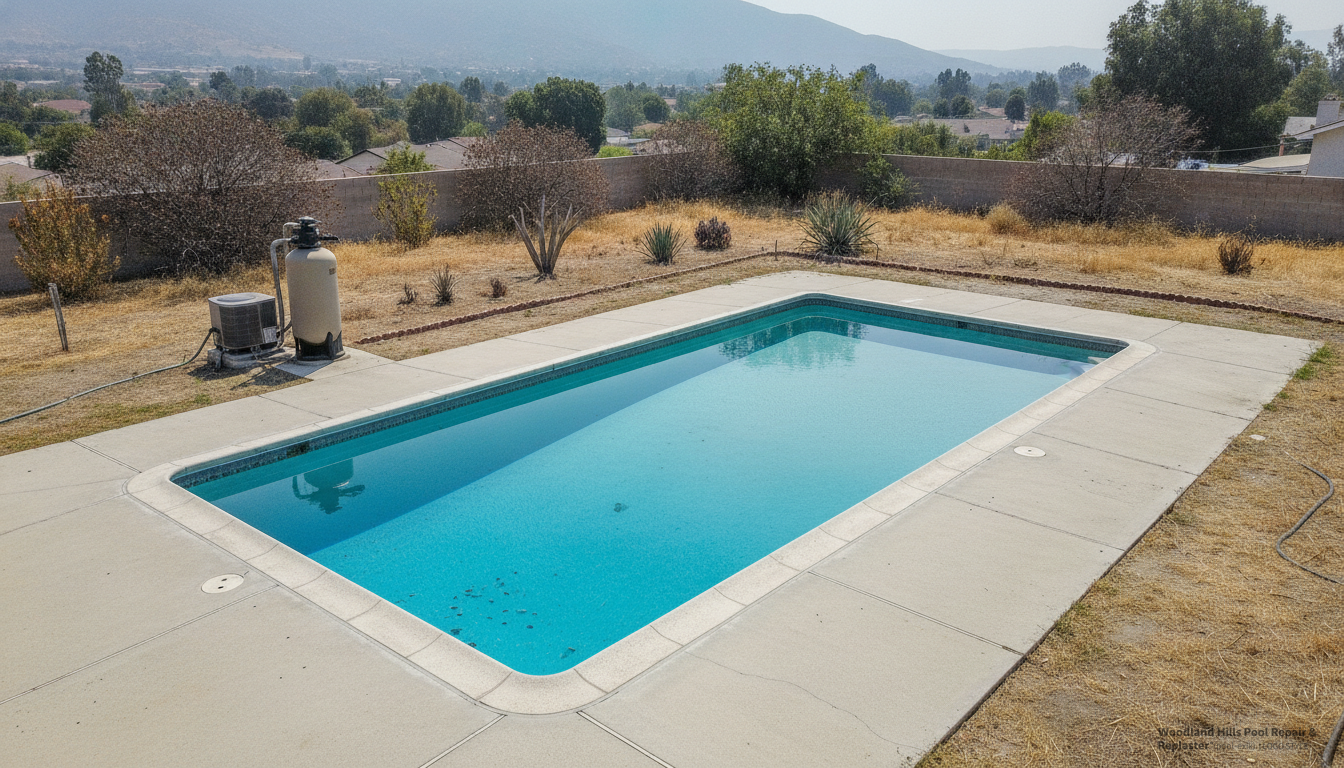
The Local Factors That Make Woodland Hills a High-Risk Pool Environment
If you own a pool in Woodland Hills and feel like you're dealing with leaks, cracks, or surface deterioration more often than neighbors in other parts of the country, you're not imagining it. The combination of environmental and geological factors specific to this corner of the San Fernando Valley creates conditions that are genuinely harder on pool shells, plumbing, and fittings than the national average. Understanding those factors is the first step toward protecting your investment.
Expansive Clay Soils: The Hidden Enemy Beneath Your Pool
Much of the San Fernando Valley — including Woodland Hills and neighboring communities like Canoga Park, West Hills, and Calabasas — sits on expansive clay soils that swell significantly when wet and shrink when dry. This repeated expansion and contraction cycle exerts lateral pressure on pool shells and underground plumbing throughout the year. The result is shell cracking along stress points — particularly at the floor-to-wall transition, around fittings, and near the main drain assembly — as well as PVC pipe joints that gradually loosen and fail under the shifting soil load.
Our pool shell crack repair technicians see clay-soil movement as a contributing factor in the majority of structural crack cases throughout Woodland Hills. Addressing cracks early — before water infiltrates the substrate and softens the soil further — is critical to avoiding a feedback loop where the leak accelerates the soil movement that causes more cracking.
Intense UV Exposure Degrades Plaster Faster Than the National Average
Woodland Hills averages over 280 sunny days per year, with summer temperatures regularly exceeding 100°F in the inland valley. That level of UV intensity and heat exposure accelerates the chemical breakdown of pool plaster significantly. Standard white marcite plaster that might last 15 years in a milder climate can become rough, chalky, and porous in 10 to 12 years under Woodland Hills conditions — creating a surface that harbors bacteria, resists cleaning, and begins to allow micro-level water infiltration through its degraded calcium matrix.
When plaster deterioration reaches this stage, individual repairs become increasingly difficult to match cosmetically and structurally. A full pool replastering project — stripping the old surface back to the gunite shell and applying a fresh, properly cured interior coat — is the only way to reset the surface to a truly watertight condition. We offer white marcite, quartz aggregate, and exposed-aggregate pebble finishes, with pebble finishes being particularly well-suited to Woodland Hills' harsh UV environment due to their superior surface hardness and chemical resistance.
Seismic Activity and Ground Movement
The greater Los Angeles area is one of the most seismically active regions in the United States, and Woodland Hills is no exception. Even minor seismic events that don't register as perceptible to residents can shift pool shells enough to open hairline cracks in plaster or separate pipe joints underground. Pools that have already developed small surface cracks are particularly vulnerable — each tremor widens existing fractures incrementally.
This is one reason we recommend prompt attention to any visible crack in your pool's shell. A hairline crack that's confirmed as a non-leaking cosmetic issue today can become an active water-loss point after the next minor seismic event. Our pool leak detection process includes dye testing of all visible cracks to establish a baseline — so you know exactly which ones are currently leaking and which to monitor going forward.
Year-Round Pool Use Means Year-Round Wear on Fittings
Unlike pools in colder climates that are winterized and closed for months each year, Woodland Hills pools typically run their filtration systems 365 days a year. That continuous operation means skimmer baskets cycle through pressure fluctuations daily, return fitting gaskets experience constant hydraulic stress, and pump unions expand and contract with every thermal cycle. The cumulative wear on these components accelerates proportionally to their operational hours.
Our skimmer and return fitting repair team recommends inspecting all fittings, gaskets, and face plates every two to three years for Woodland Hills pools that run year-round — a maintenance interval that reflects the actual operational load these components experience locally. Similarly, Tarzana and Reseda pool owners in our service area frequently report skimmer-related water loss as their most common recurring repair need.
Underground Plumbing Vulnerabilities in High-Temperature Soil
PVC plumbing buried in Woodland Hills soil is subject to significant thermal cycling as surface temperatures fluctuate between cool winter nights and scorching summer days. Over time, these thermal cycles cause PVC pipe and fittings to fatigue at joints and transitions — particularly at 90-degree elbows and tee fittings where stress concentrations already exist. A slow seep at a buried elbow can saturate the surrounding soil for months before the water finds its way to the surface and alerts a homeowner.
Our pool plumbing leak repair team uses pressure testing and acoustic listening equipment to locate underground pipe failures without exploratory excavation. When the break is confirmed, we excavate only the minimum area required, replace the compromised section with schedule-40 or schedule-80 PVC as appropriate, and pressure-test the repaired line before backfilling. For Hidden Hills estates with long underground line runs, acoustic detection is particularly valuable in minimizing landscape disturbance.
A Proactive Maintenance Strategy for Woodland Hills Pools
Given the environmental factors at play, the most cost-effective approach to pool ownership in Woodland Hills is a proactive one. Consider the following practices:
- Perform a bucket test every spring and fall to catch new leaks early before soil erosion begins
- Inspect skimmer face plates and return fitting edges visually after any significant rain or seismic event
- Schedule a professional leak detection inspection every three to four years even if you don't notice obvious symptoms — many leaks are slow enough to go unnoticed for a full season
- Address any visible shell crack promptly with a professional dye test to determine whether it's actively losing water
- Plan for replastering before the surface reaches full deterioration — proactive replastering on a 12-year cycle is less expensive than emergency structural repairs on a failed shell
Woodland Hills Pool Repair & Replaster serves homeowners throughout Woodland Hills and the surrounding San Fernando Valley, including Calabasas, West Hills, Canoga Park, Tarzana, Reseda, and Hidden Hills. We're available Monday through Sunday from 8:00 AM to 6:00 PM. Call (747) 774-4437 or email [email protected] to schedule your inspection and keep your pool watertight through every season.