
Is Your Woodland Hills Pool Losing More Water Than It Should?
Every pool loses some water to evaporation — especially during Woodland Hills' long, dry summers. But when water loss becomes consistent, unexplained, or accelerating, a leak is almost always the culprit. Left unaddressed, even a slow leak can waste tens of thousands of gallons per year, erode the soil beneath your deck, and compromise the structural integrity of your pool shell. At Woodland Hills Pool Repair & Replaster, we help homeowners across the San Fernando Valley recognize the early warning signs so small problems don't become costly disasters.
1. Your Pool Drops More Than ¼ Inch of Water Per Day
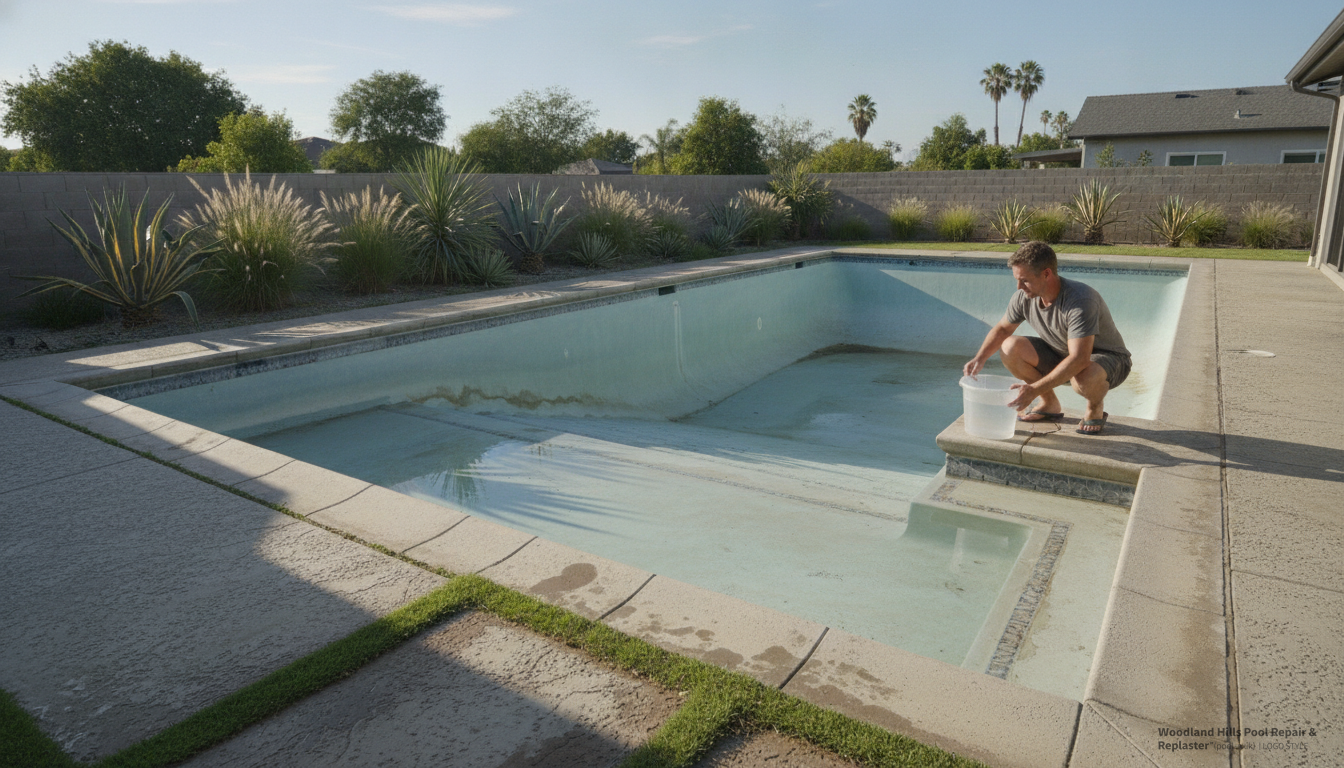
Evaporation in the Woodland Hills climate typically accounts for about ¼ inch of water loss per day during hot, dry weather. If you're noticing a drop of ½ inch or more — especially when the pool cover is on or temperatures are mild — a leak is likely. The simplest way to test this at home is the bucket method: fill a bucket with pool water, place it on a pool step, and mark both levels. After 24 hours, if the pool has lost significantly more water than the bucket, schedule a professional pool leak detection inspection immediately.
2. You're Adding Water More Than Twice a Week
If you find yourself reaching for the garden hose every few days just to keep the pool at a usable level, that's a red flag. Many homeowners normalize this behavior over months without realizing how much water — and money — is disappearing. Chronic top-offs also disrupt your pool's chemical balance, leading to increased sanitizer costs on top of the water bill. A professional inspection can pinpoint whether the source is a leaking skimmer or return fitting, a crack in the shell, or an underground plumbing break.
3. Wet Spots, Soft Ground, or Cracks in the Deck Around the Pool
Water escaping from underground plumbing doesn't stay underground forever. It saturates the sub-base soil, creating soft or spongy areas in the lawn or patio, unexplained wet patches even when it hasn't rained, and in more severe cases, visible cracking or settling in the concrete deck. If you notice any of these symptoms, the leak has likely been active long enough to begin affecting the structural environment around your pool. Our pool plumbing leak repair team excavates only the minimum area necessary to access and fix the damaged section — minimizing disruption to your backyard.
4. Visible Cracks in the Pool Shell or Plaster
A hairline crack in your pool's plaster might look purely cosmetic, but it can be actively drawing water into the gunite substrate beneath. Woodland Hills pools are particularly susceptible to shell movement due to the region's clay-heavy soils, seasonal temperature swings, and occasional seismic activity. Cracks that run along the floor-to-wall transition, near fittings, or across the deep end floor deserve immediate attention. Our pool shell crack repair service uses dye testing to confirm whether each crack is a leak point before applying epoxy injection or structural patching for a lasting seal.
5. Unexplained Increases in Your Water or Chemical Bills
A leaking pool doesn't just cost you water — it costs you the chemicals you've invested in to balance it. Every time you add fresh water to compensate for losses, you're diluting sanitizer, pH adjusters, and alkalinity stabilizers. If your chemical costs have crept up alongside your water bill without any change in pool usage, a leak is a very plausible explanation. Serving homeowners in Canoga Park, West Hills, Tarzana, and Calabasas, our team provides a complete written diagnostic report after every inspection so you understand exactly what's leaking and what it will take to fix it.
What to Do If You Spot These Signs
Don't wait to see if the problem resolves on its own — pool leaks do not self-heal. The sequence of events is almost always the same: a small crack or failing fitting grows under the pressure of the water column, soil erosion accelerates around the leak point, and what could have been a simple epoxy injection becomes a major excavation or even a full replastering project. Early detection is the single most cost-effective thing a pool owner can do.
- Perform the bucket test to confirm you have a leak versus evaporation
- Check the area around your equipment pad for dripping unions, valves, or fittings
- Look closely at skimmer face plates and return fitting edges for gaps or deteriorated gaskets
- Note whether water loss stabilizes at a particular level — this can indicate whether the leak is above or below a specific fitting
- Call a professional if any of the above confirms your suspicion
Woodland Hills Pool Repair & Replaster is available Monday through Sunday